


Andrew Wilber, PhD, honored as SIU’s 2026 Inventor of the Year
September 17, 2026
CARBONDALE, ILL.—About 100,000 Americans live with sickle cell disease, an inherited blood disorder that can cause sudden episodes of severe pain when misshapen blood cells obstruct the flow of blood and oxygen through the body. For some patients, these painful crises recur throughout their lives and require hospital care.
Andrew Wilber, PhD, is working to change that. His gene therapy research at SIU School of Medicine seeks to give people diagnosed with sickle cell anemia or the related condition, beta-thalassemia, the prospect of healthier lives. The potential impact of that work is one reason Wilber has been named Southern Illinois University System’s 2026 Inventor of the Year.
Wilber, of the Department of Medical Microbiology, Immunology and Cell Biology at SIU School of Medicine, was recognized at the SIU Board of Trustees meeting on September 17.
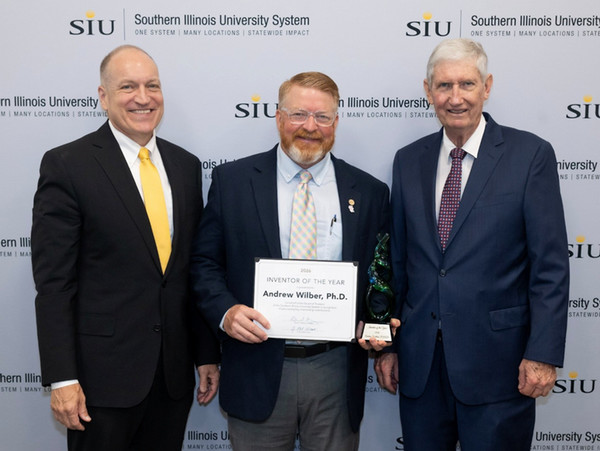
(L to R) SIU President Dan Mahony, Dr. Wilber and SIU Board Chair J. Phil Gilbert.
The award honors an exemplary faculty member who has demonstrated the ability to innovate at the highest level and contribute to the betterment of society by taking meaningful steps to advance scientific achievement. Recipients must have worked with SIU’s Office of Technology Management and Industry Relations (OTMIR) to produce patents and exhibit a record of success in developing their discoveries.
“The scientific discoveries that shape our understanding of these diseases are the bedrock of why research should be supported and celebrated,” said Robert Patino, OTMIR director. “But these discoveries are only part of the story. The work that goes into protecting and preserving these breakthroughs is no small task. It allows for private investment to enable this work to reach the public. Dr. Wilber’s efforts provide hope for patients with serious illnesses and bring recognition to SIU’s world-class research.”
Wilber has been collaborating with Dr. Frank Park of the University of Tennessee Health Science Center College of Pharmacy to develop a new genetic therapy designed to improve the lives of patients diagnosed with sickle cell anemia or beta-thalassemia. These debilitating blood disorders are caused by a defect or deficiency in adult hemoglobin, the molecule used by red blood cells to carry oxygen throughout the body.
In scientific terms, the researchers are developing a system to introduce a healthy version of adult hemoglobin into the patient’s own hematopoietic stem cells, which are specialized cells that can form any type of blood cell in the body. This represents a one-time treatment option capable of restoring adult hemoglobin to healthy levels and significantly improving a patient’s quality of life. Both the treatment and subsequent improvements will be monitored using the team’s companion diagnostic test that a commercial partner is testing in clinical trials.
Wilber’s work has resulted in 14 active patent applications being pursued around the world.
“I’m very honored to receive this recognition,” said Wilber. “This work is the product of more than 15 years of research, which was only possible through support provided from SIU, my department chair, Dr. Shelley Tischkau, and Associate Dean for Research Dr. Donald Torry. I’m grateful for the opportunity to pursue this work, and I am excited that it may be able to improve the overall health and lives of patients with these serious conditions,” he said.
“I also want to acknowledge my collaborator at the University of Tennessee Health Science Center, Dr. Frank Park, and a talented team of researchers and students to include Dr. Christopher Chambers, Catherine Mirto, Nicole Townsend, Kylie Mably and Bryn Bates. These efforts required a dedicated team with a shared vision and passion for discovery-based science. Our journey has not always been easy, but I hope it has been rewarding for all involved.”
Wilber received his PhD in molecular genetics from the University of Minnesota and completed a postdoctoral fellowship in experimental hematology at St. Jude Children’s Research Hospital. He is a professor in the Department of Medical Microbiology, Immunology and Cell Biology. He serves as director of graduate studies for the Cell Biology, Immunology and Cancer Biology Graduate Program as well as director of the Hematology, Immunology and Infectious Disease Pre-Clinical Medical Unit. He has published numerous journal articles and received many awards for his teaching and research.
About the Southern Illinois University System
Founded in 1869, the Southern Illinois University System includes nationally recognized public universities serving more than 25,700 students across two institutions: Southern Illinois University Carbondale (SIUC) and Southern Illinois University Edwardsville (SIUE). SIUC includes a School of Law in Carbondale and a School of Medicine in Springfield. SIUE includes a School of Pharmacy in Edwardsville, a School of Dental Medicine in Alton, the Southwestern Illinois Justice and Workforce Development Campus in Belleville and the East St. Louis Center. Employing more than 7,400 faculty and staff, the SIU System is a major economic driver for central and southern Illinois and offers a wide range of academic programs leading to associate, bachelor’s, master’s, specialist, doctoral and professional degrees including law, medicine, pharmacy and dental medicine.
